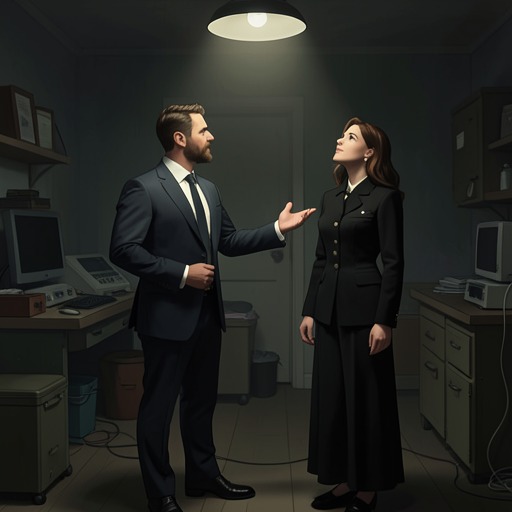
Scandal at Sexton’s Washington Monument press conference
Deception PointScandal at Sexton’s Washington Monument press conference is a planned political disclosure that collapses into a personal and public exposure. Senator Sedgewick Sexton arrives expecting to use evidence against NASA to define his political future; instead, the contents of his carefully prepared envelopes reveal his relationship with Gabrielle Ashe. The reversal entwines the dispute over the alleged meteorite fraud with the campaign’s deeper contest over credibility, ambition, and who controls the public account of events.
Causes and Political Stakes
Sexton’s attack on NASA had begun as a campaign strategy. Faced with the agency’s failed missions and major budget overruns, he made it a prominent example of government waste and used it to challenge President Zach Herney. Gabrielle had helped shape that strategy: while working in Sexton’s Washington campaign office, she urged him to make NASA spending a political issue, supplying figures about the agency’s costs, failures, and bailouts. NASA became both a policy target and a tool for building Sexton’s campaign.
The controversy sharpened when Sexton raised rumors of another NASA failure during a public exchange with Marjorie Tench. Tench turned the discussion into a direct test of his position, asking whether he would abolish NASA if space exploration could not be done for less than the agency was spending. The question forced Sexton toward a categorical stance. Later, when NASA’s claimed discovery of extraterrestrial life was announced, that stance became a political liability: the discovery promised to restore the agency’s standing and strengthen Herney’s campaign, while Sexton’s willingness to abolish NASA funding made him vulnerable to the announcement’s political impact.
Herney had announced that he would disclose the discovery at a White House press conference at eight that evening. He had also stressed that the scientific claim had been checked by four civilian scientists who used their own equipment and reached independent conclusions. Yet Herney worried that political opponents could cast doubt on the discovery and shift public attention from evidence of extraterrestrial life to allegations of conspiracy. In that atmosphere, the question of whether the meteorite was genuine had become inseparable from the question of who could be trusted to present the evidence.
Sexton’s Plan and Gabrielle’s Warning
After receiving Rachel’s materials, Sexton prepared ten identical stacks of photocopies. They included the evidence Rachel had sent and her handwritten claim that the meteorite was fake and that NASA and the White House were trying to kill her. He placed each stack in a white linen envelope marked with his name, office address, and senatorial seal. The presentation was part of the message: Sexton wanted the documents’ source to be unmistakable and their release to look like a decisive act of political disclosure.
Gabrielle urged him not to proceed. She warned that Rachel’s life was at risk and argued that Sexton could wait until Rachel was safe and he had spoken with William Pickering. Sexton ignored her appeal, treating the disclosures as the opportunity that could carry him to the presidency. When Gabrielle threatened to reveal their affair, he dismissed her credibility, confident that he had denied the relationship before and could do so again. He also rejected the possibility that photographs could harm him and claimed that the envelopes’ evidence outweighed anything that might be used against him.
His preparations made the conflict tangible. He sealed the envelopes with crimson wax seals bearing his initials, turning them into polished, personal-looking packages. Gabrielle saw that his ambition had displaced concern for Rachel. Her warning that he had already won politically, and should wait until Rachel’s safety was assured, did not change his decision. The sealed envelopes represented Sexton’s confidence that controlling the timing and form of a disclosure would let him control its meaning.
The Press Conference Reversal
On a clear Washington morning, Sexton arrived at the base of the Washington Monument to address reporters from the ten largest media networks. He carried the ten sealed envelopes and had arranged the podium with large partitions to frame his appearance. Before distributing the material, he told the press that the envelopes contained proof of deceit at the highest levels of government, and claimed that Herney had called half an hour earlier to beg him not to release it. He presented himself as a man willing to reveal painful truths.
Rachel arrived while Sexton was at the podium. He drew her behind one of the partitions, away from the reporters’ view; there, she confronted him and slapped him. Rachel told him that she had turned to him for help and that he had sold her out, leaving her nearly killed. Their encounter placed the family betrayal behind the public performance: Sexton could speak of truth to the press while refusing to heed his daughter’s warning.
A reporter in a cashmere coat and mohair beret knocked the envelopes from the ground while attaching a microphone. Sexton blamed the interruption on Rachel’s distraction. The reporter gathered the envelopes and handed them back without looking up; Sexton counted all ten, reassured that the presentation remained intact, and resumed addressing the crowd. The brief disruption concealed the decisive switch: the reporter was Gabrielle, who had kept another set of envelopes under her coat.
Sexton handed his envelopes to the waiting reporters. As they opened them, the crowd fell silent. He expected the documents to reveal the meteorite fraud, including images of an insertion shaft beneath the ice, evidence of a living ocean species resembling the NASA fossils, and evidence that the chondrules had formed on Earth. A reporter called the material scandalous but asked why Sexton was releasing it after having denied it so vehemently earlier. When the reporter returned the pages, Sexton found photographs of himself and Gabrielle instead. The press began laughing and reporting the story.
Exposure and Aftermath
Rachel stood beside Gabrielle and told her father that they had tried to stop him and had given him every chance. Gabrielle then revealed the envelopes she had kept beneath her coat, confirming that the apparent mishap had allowed her to replace Sexton’s material before it reached the reporters. The documents Sexton had prepared as proof against NASA had become the means of exposing his affair. His attempt to dictate the press conference’s meaning was undone in front of the audience he had assembled to advance his campaign.
The scene reverses the political spectacle Sexton had staged. He had treated information as a weapon and believed that the Senatorial seal, the timing, and the dramatic setting would make his disclosure authoritative. Instead, the press’s silence, confusion, and laughter marked the collapse of his expected revelation. At the Washington Monument, the evidence he had meant to circulate against the White House did not appear; the photographs exposed Sexton himself.
The scandal also closes the gap between public argument and private conduct. Sexton’s campaign had used NASA’s costs and failures to question Herney’s judgment, while the President’s announcement transformed the discovery into a test of public confidence in science and government. At the press conference, Sexton’s personal credibility becomes the immediate issue. The episode’s central reversal is not simply that one set of papers replaces another: the senator who expected to expose a government deception is himself publicly exposed, and the carefully sealed envelopes become instruments of a political defeat he had refused to anticipate.